

The bus smelled like old vinyl and diesel. Marcus sat by the window with a paper bag at his feet and a plastic folder on his lap. Inside the folder were the only things the prison said were his: a birth certificate, a worn photo of a little girl with two missing front teeth, and a release form stamped in purple ink.
Home was three hours away.
He watched the highway unspool in gray ribbons. Every mile marker felt like a question. Who would he be when he stepped off this bus? Who would be waiting?
He had practiced this moment for years. In his cell, after count, he would lie on his back and picture the front door of his mother’s house. The paint was once blue. It might be another color now. He imagined knocking. He imagined his mother’s hands, still strong from years of factory work, pulling him into her chest. He imagined his daughter, grown taller than the last time he saw her, studying his face like a stranger’s.
He was afraid of that part.
When he went in, Lila was five. She used to fall asleep with her cheek pressed to his arm while he read the same book over and over because it was the only one she liked. He missed her first day of school. He missed the time she broke her arm. He missed the way her voice changed.
He wrote letters every week. Sometimes they came back. Sometimes they didn’t. His mother kept writing. Short notes about the garden. About the neighbor’s dog. About Lila winning a spelling bee. She never wrote about the shame. He felt it anyway.
The bus stopped at a gas station halfway through the trip. Marcus didn’t get off. He pressed his forehead to the cool glass and watched a father lift a little boy onto his shoulders. The boy laughed like it was the easiest thing in the world.
Marcus closed his eyes.
When the bus finally pulled into his town, it looked smaller. The grocery store sign flickered. The diner on the corner had new windows. The sky felt lower, like it was watching him.
He stepped down onto the pavement with the paper bag and the folder. For a moment, no one moved toward him. People passed by with their own bags, their own lives. He wondered if freedom was supposed to feel louder.
“Marcus.”
He turned.
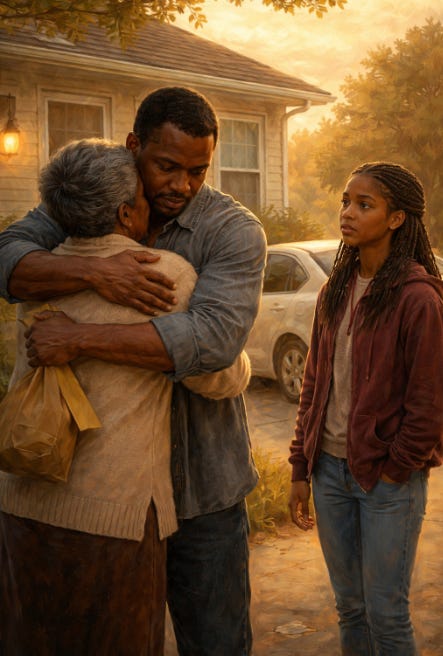
His mother stood near the curb, her coat buttoned wrong, as if she had dressed in a hurry. Her hair was more gray than he remembered. She didn’t walk to him at first. She just looked. Taking inventory. Making sure he was real.
Then she crossed the space between them in quick, uneven steps.
He dropped the bag. It tipped, and a pair of secondhand boots spilled onto the pavement. She wrapped her arms around him, and he felt how small she had become. Or maybe he had just grown harder.
“You’re home,” she said into his chest.
Home.
He held her carefully, like she might break.
A car idled at the curb. He saw her then. Lila sat in the passenger seat, hands folded in her lap. She wasn’t a little girl anymore. She had her mother’s eyes. She looked at him the way he had imagined, steady and unsure.
He didn’t move right away. Fear pinned his feet. What if she saw the years on him and decided they were too heavy?
His mother squeezed his arm and let go. “Go on,” she said softly.
He walked to the car.
Up close, he could see a small scar on Lila’s chin he didn’t recognize. Evidence of a moment he hadn’t been there for. He felt the absence like a physical ache.
“Hi,” he said. His voice cracked on one syllable.
“Hi,” she answered.
There was a long silence. Traffic moved around them. Somewhere, a siren wailed and faded.
“I’m sorry,” he said, because he had promised himself he wouldn’t start with excuses.
She studied him. He braced for anger. For tears.
Instead, she opened the car door and stepped out. She was almost as tall as he was. “Grandma said you’d say that,” she said. “I know.”
The words were simple. They landed gently.
He swallowed. “You don’t have to forgive me today.”
She shrugged, a small, familiar motion. “I just want to go home.”
He nodded.
The ride to the house was quiet. He watched the streets he used to know. The corner where he taught Lila to ride a bike. The park where he once pushed her on a swing until his arms burned. Everything was still there. And not.
When they pulled into the driveway, he saw the door. It wasn’t blue anymore. It was white.
He stood in front of it, heart pounding harder than it had on the day of his sentencing. His mother unlocked it and stepped aside.
“After you,” she said.
The house smelled like coffee and lemon cleaner. A clock ticked in the kitchen. On the wall hung school pictures of Lila, one for every year he’d been gone. He walked toward them slowly, counting.
“Mom kept them up so you could see,” Lila said behind him.
He touched the frame of the most recent photo. She was smiling, but there was something careful in it. A guardedness he had helped create.
“I want to earn it,” he said quietly. “Not just walk in like I never left.”
Lila leaned against the doorway. “Then stay,” she said. “That’s how.”
Stay.
He let the word settle into him. It was heavier than freedom. It meant early mornings and hard work. It meant showing up to school events, even if people whispered. It meant listening when Lila was angry. It meant being patient when she pulled away.
It meant building something fragile and real.
He turned from the wall of photos and faced his daughter. For the first time that day, he felt something steady under his feet.
“I’m not going anywhere,” he said.
Outside, the evening light slipped through the windows and laid soft gold across the floor. The door closed behind him with a quiet click.
For the first time in years, Marcus was not counting the days until he could leave.
He was counting the days he would get to stay.